

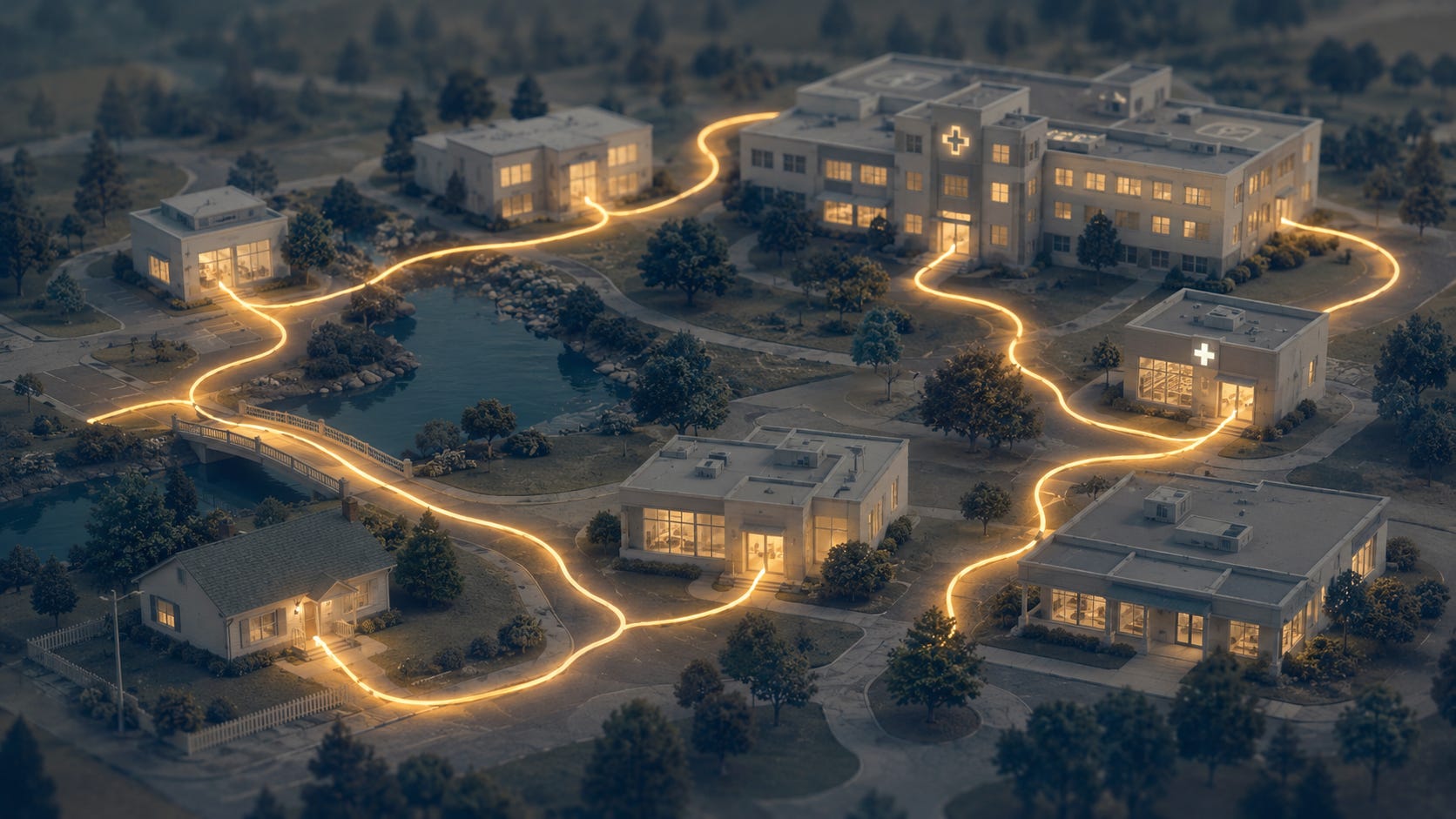
Last week I described a care layer. Something that knows a patient’s full story, persists across every organizational boundary, reaches out proactively, and is there at 2am. I wrote the job description without naming what could fill it.
Several of you emailed me the same answer. You’re right. And you’re not entirely right. Let me explain both.
Why the Technology Finally Exists
The care layer requires four capabilities that weren’t simultaneously available until recently.
Natural language interaction at human quality. The care layer needs to call Mrs. Rodriguez and have a conversation that doesn’t feel like a phone tree. It needs to detect when she says “I’m fine” but doesn’t sound fine. It needs to know that asking her to rate her grief on a scale of 1 to 10 is exactly the wrong approach, and that asking “how’s this week been?” is closer to right. Foundation models crossed this threshold in 2023. Voice-capable models are crossing it now.
Continuous synthesis across fragmented data. The care layer needs to hold information from seven organizations and notice when pieces interact: this medication plus that medication. This missed refill plus that behavioral pattern. This requires both data access (FHIR and TEFCA are making this real, slowly) and reasoning over that data (which large language models can do in ways rule-based systems never could).
Proactive outreach at scale. A human care manager maintains deep relationships with 60-80 patients. The care layer needs to maintain them with thousands, without losing the thread of any individual story. This changes the economics of the entire model. Not replacing care managers. Extending their reach by an order of magnitude, so the care manager spends her time on the patients who need a human, not on the 400 check-in calls that could have been handled before they became crises.
Contextual escalation. The care layer needs to know when to handle something and when to get a human. Mrs. Rodriguez’s 2am breathing difficulty might be anxiety the care layer can talk through. It might be cardiac. The layer must tell the difference, and when it can’t, default to caution immediately. This requires clinical judgment that rule-based systems never achieved and that AI is only beginning to demonstrate reliably. I want to be honest about the word “beginning.” We’re not there yet on the hardest cases. We’re close enough to start on the cases where the risk of inaction is higher than the risk of imperfect action.
Why “It’s AI” Is Not Enough
I’ve watched enough technology deployments fail in healthcare to know that capability doesn’t equal adoption and adoption doesn’t equal impact.
The 14-site CIN story from last week haunts me because it’s the most common failure mode: the technology works, the organization can’t absorb what the technology reveals. You surface 9,000 care gaps and twelve care managers drown in alerts they can’t act on. The platform becomes noise. The care managers resent it. The physicians ignore it. Eighteen months later, the contract isn’t renewed and everyone agrees that “the technology wasn’t ready” when really the implementation model wasn’t designed for the organizational reality.
The care layer only works if it doesn’t just detect problems but acts on them. And “acts on them” means something specific: it engages the patient directly, handles what it can handle, and routes to a human only what requires a human. If it’s another alerting system that adds to care manager workload, it will fail the same way everything else has failed.
The Root Cause
Here’s what I’ve come to believe through writing this series: every organizational model I’ve mapped exists because we failed primary care.
Not because primary care failed. Because we failed it.
Patients go to the ER for earaches because we made it impossible to see a PCP within 48 hours. ACOs exist because we built a payment system that gave PCPs no time or incentive to coordinate care. SNF costs explode because we designed a discharge process where nobody follows the patient home. Behavioral health is siloed because we never gave PCPs the time to screen, the tools to intervene, or the referral pathways that actually connect. CINs and IPAs were invented because we left individual PCP practices so resource-starved that they couldn’t participate in value-based contracts alone.
The average primary care physician has 2,200 patients, 15-minute visits, two hours of documentation for every hour of patient care, and reimbursement at a fraction of procedural specialists. We built a system that made primary care unsustainable, then invented thirty organizational models to compensate for the consequences.
We don’t need a 31st model. We need to rebuild primary care so that it becomes what it was always supposed to be: continuous, contextual, and present in the patient’s life. Not just during the twelve minutes she sits in the exam room.
If We Get This Right
If the care layer existed and primary care were rebuilt around continuous presence, half the organizational complexity in this series would simplify.
Urgent care clinics handle fewer earaches because the patient can reach her PCP same-day through an asynchronous channel. Hospital readmissions drop because someone catches the missed medication on day three. Behavioral health stops being siloed because screening and follow-up happen inside the ongoing relationship. SNF stays shorten because the transition home is coordinated and confirmed. The CIN’s overhead drops because care management is ambient. The ACO’s quality reporting becomes a byproduct, not a burden.
The organizational models don’t disappear. People still get sick. They still need surgery. They still need rehabilitation. But the edges between models smooth out. The transitions stop being cliffs where patients fall off.
Three Things That Must Be True
The care layer doesn’t work in isolation. Three conditions have to hold simultaneously.
Value-based payment must become dominant. The care layer has no business model under fee-for-service. It pays for itself only when someone captures the economic value of prevented ER visits, prevented readmissions, and healthier patients. MA enrollment passed 50%. MSSP covers 11 million beneficiaries. Medicaid managed care covers 70%+. But fee-for-service still dominates total revenue for most providers. Until that tips, the care layer is a cost center, not a business.
Patients must control their data access. The care layer can only see across all thirty organizational models if the patient authorizes it. FHIR and TEFCA are building the pipes. But the consent model, the trust model, and the privacy framework are still being figured out. And here’s the hard part nobody wants to say: most patients over 65 have no idea what FHIR is and don’t want to manage data permissions. The consent experience has to be as simple as “do you want someone looking out for you? Yes or no.” If it requires a settings page, we’ve already lost.
The care layer must be independent of any single entity. This is the hardest requirement and the one I’m least sure how to achieve. If an IDN builds it, it optimizes for the IDN. If an MA plan builds it, it optimizes for the plan’s cost targets. If a tech company builds it, it optimizes for engagement metrics.
The care layer works for Mrs. Rodriguez only if it’s accountable to Mrs. Rodriguez. I don’t know exactly what organizational form achieves that independence. It might be a public utility model. It might be a patient-owned cooperative. It might be a new kind of entity we haven’t conceived yet. I know the question matters more than the current answer.
What I Believe, and What It Costs
I didn’t write 44 posts about healthcare’s organizational complexity as an intellectual exercise. I spend every working day building toward the problem this series describes.
I believe the answer is an intelligence layer that knows the patient’s full story and navigates all thirty models on their behalf.
I believe AI makes that possible now in a way it wasn’t two years ago.
I believe the biggest obstacle isn’t technology. It’s that building this properly means challenging the organizational boundaries that every incumbent has spent decades constructing and defending. Saying this out loud, publicly, as someone who works inside the healthcare system, is not a costless statement. The people who build the walls don’t love the people who argue the walls need to come down.
I believe we failed primary care, and that primary care is where the rebuilding starts.
I believe the people who build this will do more for Mrs. Rodriguez than any merger, any regulation, or any payment model ever has.
And I believe she’s waited long enough.
This series is becoming a book. “The Healthcare Org Chart Nobody Gave You” will be available as a complete downloadable reference, including all 30 model profiles, the visual framework, and these four essays. Subscribe if you want it when it drops.